Fixed Points and Stochastic Meritocracies: A Long-Term Perspective
Authors: Gaurab Pokharel¹, Diptangshu Sen², Sanmay Das¹, and Juba Ziani²
Affiliations: ¹Virginia Tech, ²Georgia Tech
Overview
Many high-stakes allocation systems are meritocratic at the point of decision (admit the strongest applicants, hire the top candidates, etc.).
But when the program itself changes future “merit” (e.g., college boosts future outcomes), meritocracy can create feedback loops.
This project studies a simple question:
If two groups start out identical, can a merit-based, individually-fair selection rule still generate persistent group inequality over time?
Setup (Stylized Inter-generational Model)
We model two equally-sized groups that evolve across generations.
- A scarce program (think “college”) has capacity α (a fixed fraction of the population per generation).
- Selection is deterministic and meritocratic each generation (a best-case setting for fairness).
- The “benefit” of admission is encoded by a success probability p (admitted individuals become “high-type” next generation with probability p).
- Non-admitted individuals evolve according to one of two transition models:
Model 1: Equal Advantage (EA)
Both groups face the same dynamics. Randomness can create a temporary lead, but there is no feedback advantage for the leader.
Model 2: Affinity Advantage (AA)
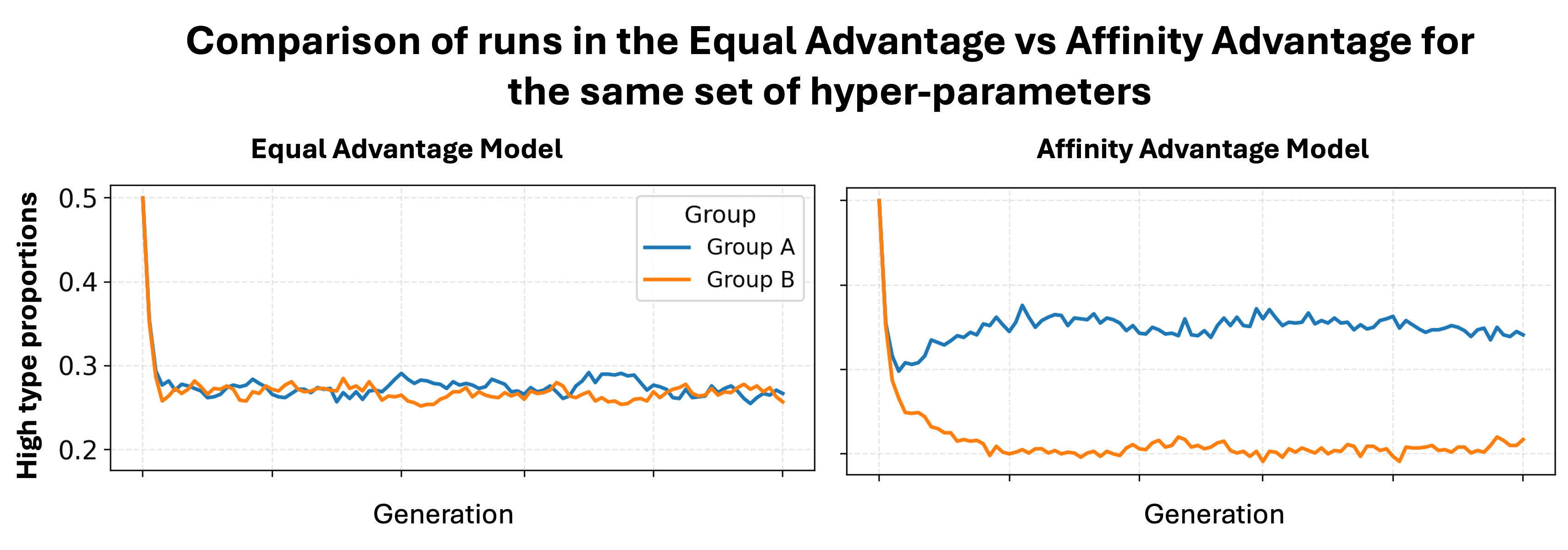
A minimal feedback loop: if one group is ahead, its non-admitted members get a small advantage ε in becoming high-type next generation.
Main Results (Intuition)
1) Symmetry does not imply equal outcomes at all times
Even from identical starting conditions, stochasticity can produce sizeable group gaps—especially when populations are small.
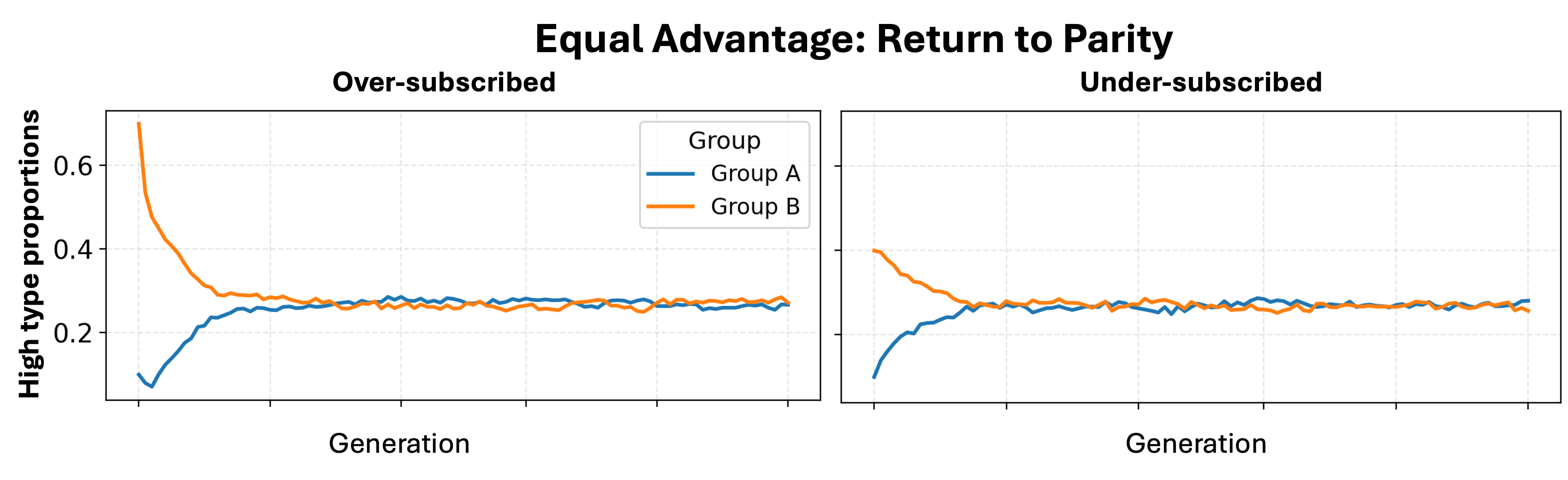
2) Equal Advantage eventually returns to parity
Under EA, the system converges to a unique parity fixed point where both groups have the same long-run fraction of high-types.
3) A tiny Affinity Advantage can lock in permanent separation
Under AA, even a small ε can create persistent long-run separation: stochastic leads appear, then the feedback loop reinforces them.
4) A sharp threshold for extreme dominance
In the AA model (α < 1/2), there is a threshold $\tilde{\epsilon} = \frac{2\alpha(1-p)}{1-2\alpha}$ that separates regimes where the leading group can eventually become overwhelmingly dominant.
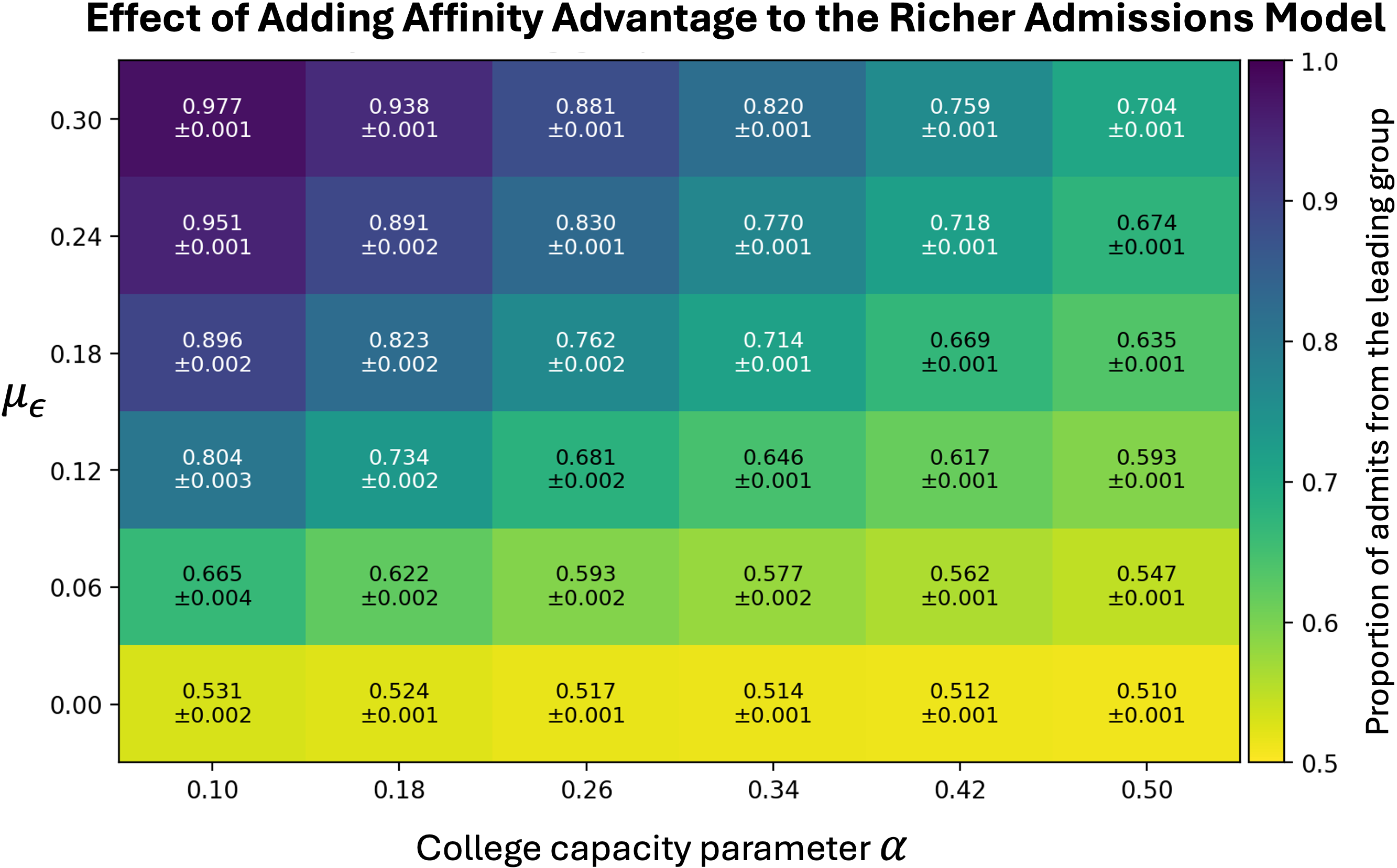
Richer Simulation Model
To test robustness beyond binary “types,” we also simulate a richer continuous-ability model where:
- Admitted individuals get a stochastic ability boost,
- Ability transmits imperfectly across generations,
- The leading group’s non-admits receive an additional stochastic “affinity” boost.
Why this matters (for algorithmic fairness)
Static, one-shot fairness can look “perfect” in each round, yet long-run disparities can still:
- arise due to randomness,
- persist due to feedback loops,
- worsen under scarcity.
This suggests fairness interventions should explicitly reason about dynamics, scarcity, and long-run equilibria, not only per-round constraints.
Citation
@article{Pokharel_Sen_Das_Ziani_2025,
  title={Fixed Points and Stochastic Meritocracies: A Long-Term Perspective},
  author={Pokharel, Gaurab and Sen, Diptangshu and Das, Sanmay and Ziani, Juba},
  year={2025},
  url={http://arxiv.org/abs/2510.07478},
  doi={10.48550/arXiv.2510.07478}
}
Work supposed by US National Science Foundation (NSF) under grants IIS-2504990, IIS-2336236 and IIS-2533162.