Budgeting Discretion: Theory and Evidence on Street-Level Decision-Making
Authors: Gaurab Pokharel¹, Sanmay Das¹, and Patrick J. Fowler²
Affiliations: ¹Virginia Tech, ²Washington University in St. Louis
Overview
Street-level bureaucrats (caseworkers, triage nurses, etc.) constantly balance rigid policy rules with the complex reality of individual cases. While they often have the professional authority to override a default recommendation, this discretion is a finite resource—using it today reduces the ability to use it tomorrow.
In this paper, we formalize this dilemma as Budgeted Discretion. We model it as a dynamic allocation problem where an agent must choose when to spend a limited "override budget" over a finite time horizon to maximize total welfare.
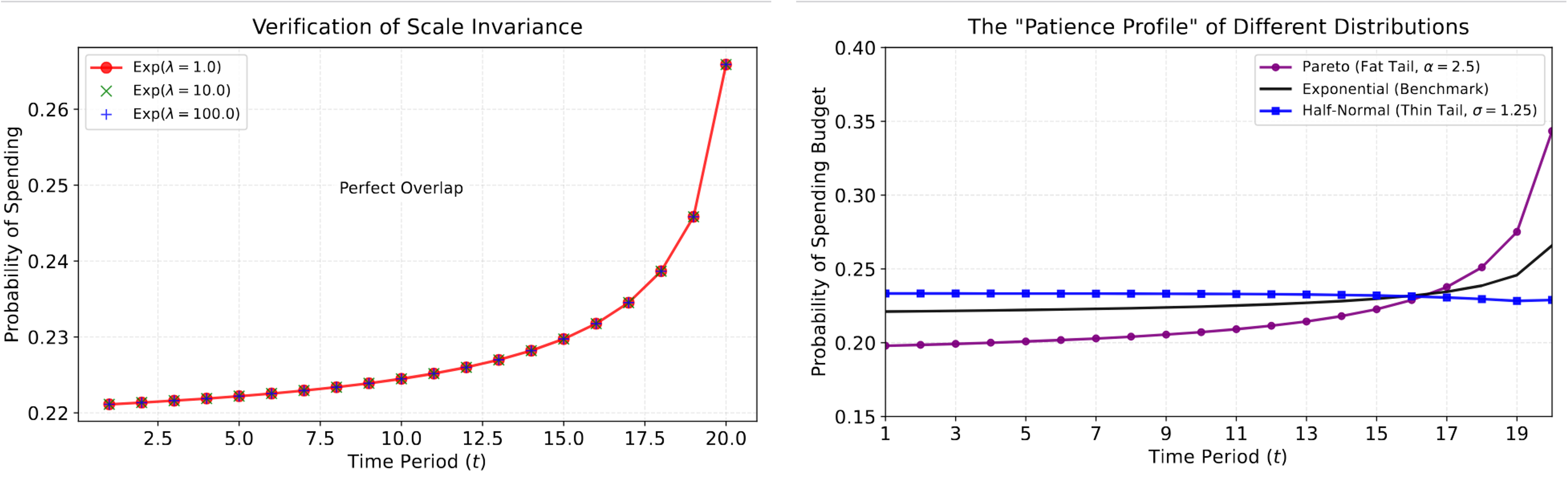
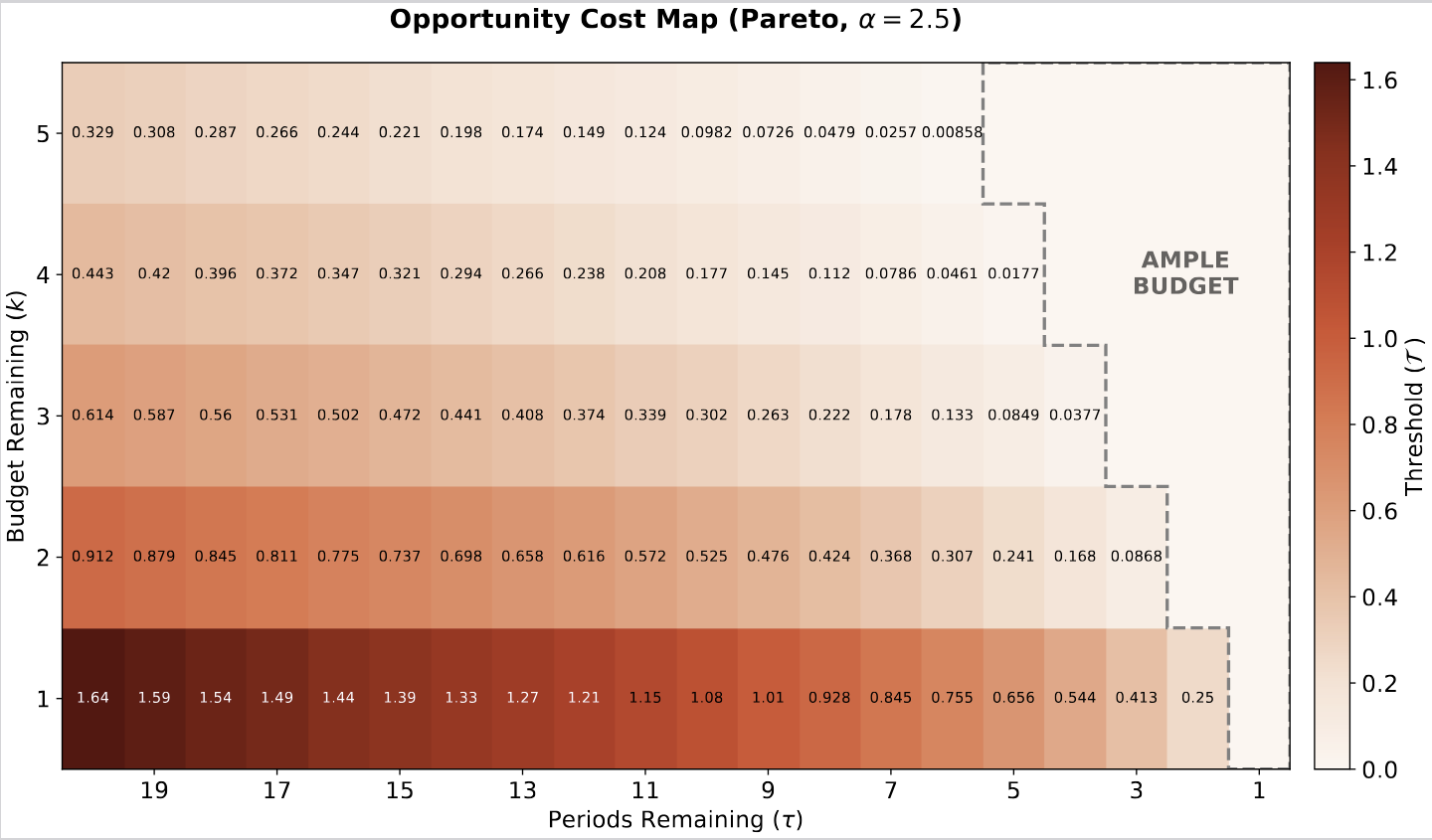
Key Takeaway: Optimal agents follow a simple threshold rule—they "hold their fire" and conserve discretion for rare, high-stakes outliers when the potential welfare gains are fat-tailed (highly varied), but spend more routinely when gains are thin-tailed (more uniform).
Theoretical Contribution
The Behavioral Invariance Theorem
We identify a "behavioral invariance" in optimal decision-making. For location-scale families of improvement distributions, the rate at which an optimal agent exercises discretion is independent of the scale of potential gains and depends only on the distribution's shape (its tail profile).
This yields a unit-free prediction: changing the units of measurement (e.g., dollars vs. thousands) changes the numerical thresholds but does not change the probability that an agent will choose to override at a given state.
Empirical Evidence: Homelessness Services
Using operational data from the St. Louis Homeless Management Information System (HMIS) between 2008 and 2014, we test if real-world overrides track operational constraints. We recover a baseline "heuristic policy" using decision trees and define discretion as any instance where a caseworker deviates from this baseline.
Key Findings:
-
Strategic Rationing: Caseworkers dynamically adjust their rationing based on inventory. The probability of "rationing" (moving a client from scarce housing back to the default shelter) rises when shelter exits create openings and falls when housing exits expand availability.
-
Operational Bandwidth: Discretion is not a frictionless exercise. It peaks on Mondays (reflecting start-of-week batching) and drops significantly on weekends when intake operations are effectively offline.
Seasonality: Overrides are more "front-loaded" early in the federal fiscal year (starting in October), with the composition shifting toward more "upgrades" as the year progresses.
Implications for AI & Decision Support
Our results provide a foundation for designing decision-support systems that preserve beneficial human judgment without forgoing oversight. If overrides are scarce, systems should assist bureaucrats not just in which cases merit discretion, but when to deploy it given future option values and workflow constraints.
Citation
 @article{Pokharel_Das_Fowler_2026,
     title={Budgeting Discretion: Theory and Evidence on Street-Level Decision-Making},
     rights={Creative Commons Attribution 4.0 International},
     url={https://arxiv.org/abs/2602.10039},
     DOI={10.48550/ARXIV.2602.10039},
     publisher={arXiv},
     author={Pokharel, Gaurab and Das, Sanmay and Fowler, Patrick J.},
     year={2026}
}
This work was supported by NSF Award 2533162.